
A drip campaign is a series of pre-written emails sent automatically on a schedule after someone takes a specific action, such as signing up, starting a trial or downloading a guide. The distinction that matters most is timer versus behaviour, not drip versus newsletter. A pure drip sends email four on day ten even if the reader bought on day two. A good one keeps the schedule but adds exit conditions, so the sequence stops as soon as it has done its job.
TL;DR:
- A drip campaign is a timed series of automated emails triggered by one action. The name comes from drip irrigation: small amounts, delivered steadily.
- Every drip needs an exit condition. A sequence that keeps selling to someone who has already bought is the most common way drips generate complaints.
- Most drips should run 3–7 emails. Match the length to the decision being made: about 10 days for a welcome series, the length of the trial for onboarding, and months for property or B2B leads.
- Google tells bulk senders to keep spam complaints below 0.3% and to offer one-click unsubscribe. Your drip has to meet that rule on every send.
- Sending is cheap: 80,000 drip emails cost $8 on Amazon SES at $0.10 per 1,000. Per-contact pricing on the platform is usually the expensive part.
Table of Contents
- What a Drip Campaign Is in Marketing, and Why It's Called That
- Drip Campaign vs Nurture Campaign: The Distinction That Changes What You Build
- Drip Campaign Examples Worth Copying, by Situation
- A Worked Example: A Five-Email Welcome Drip, Email by Email
- How Long a Drip Campaign Should Be, and When to Stop It
- The Rules Your Drip Has to Follow: Consent, Unsubscribe and the Complaint Line
- What Drip Campaign Software Should Do, and What It Actually Costs
- Run Every Drip You Need Without a Per-Contact Bill
- Frequently Asked Questions
- Sources
What a Drip Campaign Is in Marketing, and Why It's Called That

In marketing, a drip campaign is an automated sequence of emails. The content and timing are written in advance, and the whole series is triggered by a single event. Someone joins your list, and email one goes out immediately. Email two follows two days later and email three on day five. Nobody presses send. Each subscriber moves through the sequence on their own clock, starting from the moment they triggered it.
The name comes from drip irrigation, where water reaches a plant in small, regular amounts instead of one flood. The marketing version works the same way. You send a few useful messages spaced out over days or weeks, rather than one long email that tries to do everything. The idea is older than email. Direct-mail marketers ran timed postal sequences for decades before automation software made the same thing nearly free to send.
What separates a drip from a broadcast is the trigger. A newsletter goes to your whole list at a time you choose. A drip goes to one person at a time, at a moment they chose by taking an action. That is why drips tend to outperform broadcasts. Each email arrives when the reader's interest is fresh and specific, and you are not reaching them in the middle of an unrelated week.
Drip Campaign vs Nurture Campaign: The Distinction That Changes What You Build

Many pages use the two terms as if they meant the same thing. They are related, but the difference affects how you set the sequence up.
| Drip campaign | Nurture campaign | |
|---|---|---|
| What moves people forward | Time: day 0, day 2, day 5 | Behaviour: clicked, visited, bought, ignored |
| Path | Same sequence for everyone | Branches depending on what the reader does |
| Typical length | 3–7 emails, days to weeks | Open-ended, weeks to months |
| Effort to build | An afternoon | Days, plus ongoing maintenance |
| Best for | Welcome, onboarding, course delivery, re-engagement | Long B2B sales cycles, high-value purchases |
My recommendation for most small businesses is a timed drip with one or two behavioural exits. A full branching nurture programme looks impressive on a whiteboard. In practice, it is often left unfinished when the person who designed it moves on. A simple drip plus a rule such as "if they buy, stop" gets you most of the benefit of a nurture campaign for a fraction of the build and upkeep.
Some cases do justify the complexity. Examples include sales cycles of three months or more, several products aimed at clearly different buyers, or a sales team that needs to know which leads are ready. If that describes you, the marketing automation software buying guide explains which tools handle branching well.
Drip Campaign Examples Worth Copying, by Situation
These are the drip email marketing patterns that most often pay for the time it takes to write them.
Welcome series
Triggered by a signup. This is the drip almost every list should have. People pay most attention just after they subscribe, so this is when you set expectations, deliver whatever you promised in exchange for the email address, and make one clear offer. Three to five emails over about ten days is enough.
Trial or onboarding sequence
Triggered by an account being created. Each email aims to get the user to one specific action that predicts they will keep using the product, such as importing data, inviting a colleague or sending a first campaign. Run the sequence for the length of the trial. A 14-day trial usually suits five or six emails, with the final one sent before the trial expires, not after.
Abandoned cart
Triggered by a checkout that was started but not finished. The usual pattern is three emails: a reminder within a few hours, a second reminder a day later, and a final nudge around day three. This type depends on your shop platform passing the cart event to your email tool, so check that integration exists before you write any copy.
Re-engagement
Triggered by a long period of inactivity, for example no opens or clicks in 90 days. Send two or three emails offering the subscriber a reason to stay, then remove anyone who does not respond. This drip mainly exists to protect your sender reputation, not to sell.
Real estate drip campaign
Triggered by a property enquiry or valuation request. Property is a slow decision. A buyer may need six to twelve months, so the drip should be long and spaced widely: a short welcome burst, then monthly local market updates and new listings that match what they asked about. Agents who send weekly emails to cold leads mostly end up with a lot of unsubscribes.
A Worked Example: A Five-Email Welcome Drip, Email by Email
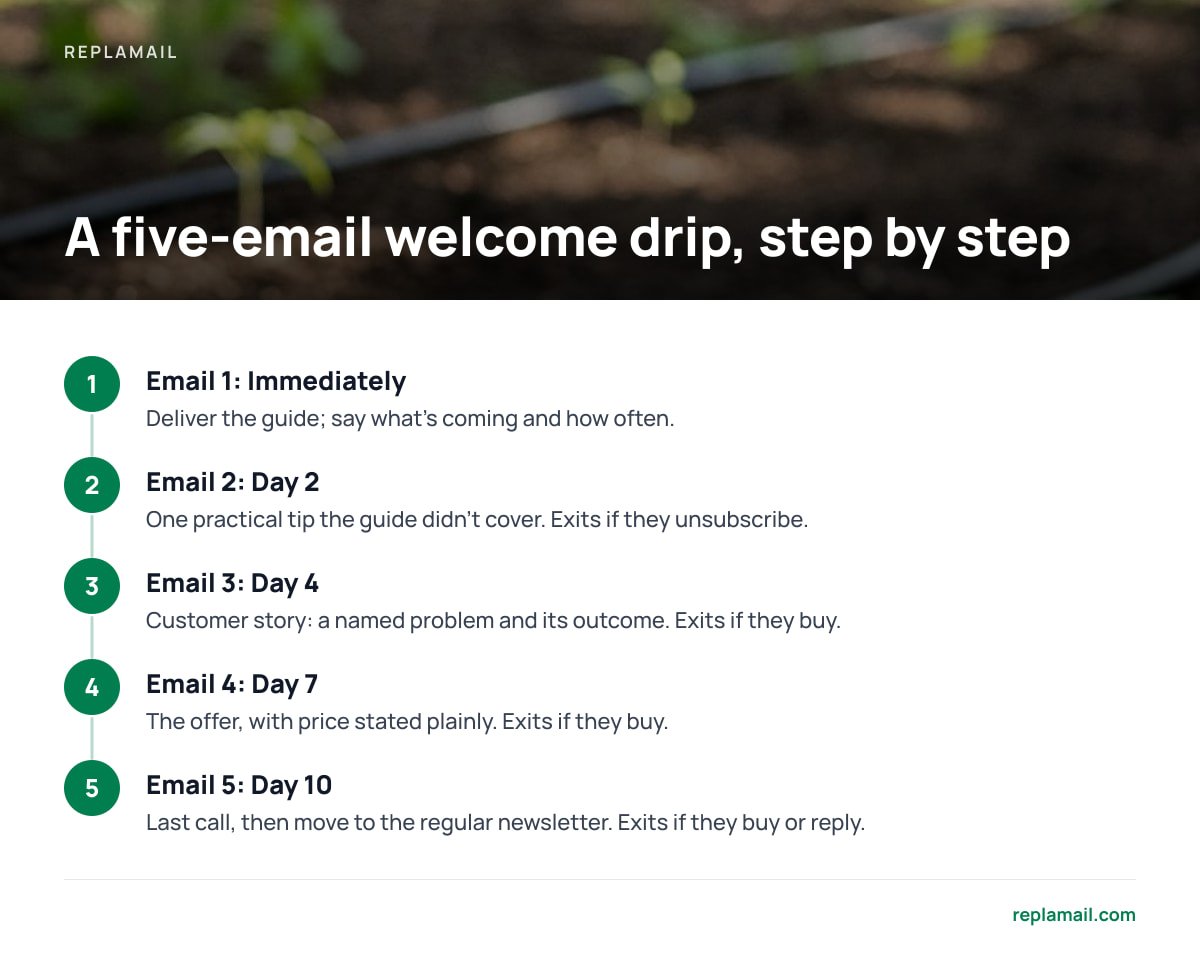
Here is a complete drip marketing example for a business that offers a free buying guide in exchange for an email address. The exit column matters most, and it is the part most sequences leave out.
| Sends | Job | Exits if… | |
|---|---|---|---|
| 1 | Immediately | Deliver the guide; say what's coming and how often | — |
| 2 | Day 2 | One practical tip the guide didn't cover | Unsubscribes |
| 3 | Day 4 | Customer story: a named problem and its outcome | Buys |
| 4 | Day 7 | The offer, with price stated plainly | Buys |
| 5 | Day 10 | Last call; then move to the regular newsletter | Buys or replies |
Email one should always go out immediately. A guide that arrives an hour after signup has already lost some of the subscriber's attention, and a delayed confirmation can make people wonder whether the form worked. Emails two and three build trust before you ask for anything. Email four makes the offer once and directly, without burying it. Email five closes the sequence and moves the subscriber onto your normal list. They should not be left in a gap where they receive nothing.
Pro Tip: Exclude anyone currently in a drip from your regular newsletter until they finish it. If you don't, a subscriber who joined on Monday can get welcome email two and your weekly newsletter on the same Wednesday. Two emails in one day from a brand they met two days earlier is exactly the pattern that makes people press "report spam" instead of unsubscribing. Most tools allow this with a segment that excludes active drip members. Few people set it up.
How Long a Drip Campaign Should Be, and When to Stop It
A drip campaign should be as long as the decision it supports, and it should stop as soon as that decision is made. In practice, that gives these ranges:
- Welcome series: 3–5 emails over 7–14 days. If they haven't bought after this, more emails rarely change that. Move them to the newsletter.
- Trial onboarding: the length of the trial. Usually 5–7 emails, with the final reminder sent two or three days before expiry.
- Abandoned cart: 2–3 emails over about 72 hours. After that, the intent to buy has usually passed.
- B2B or property leads: 6–12 emails over 2–6 months. Space them weekly at first, then monthly.
It seems logical that more emails would produce more sales. That stops being true at a specific point. Each extra email in a drip goes to the people who did not respond to the previous ones, so the audience for every later email is less interested than the one before. By email eight, you are mostly writing to people who are deciding whether to unsubscribe or report you. Watch the unsubscribe rate for each email in the sequence. When one email shows a clear jump compared with the one before it, end the sequence there.
0.3%. That is the spam complaint rate Google tells bulk senders to stay below, and a long drip sent to uninterested readers is one of the quickest ways to reach it.
The Rules Your Drip Has to Follow: Consent, Unsubscribe and the Complaint Line
Because a drip is automated, any mistake in it is repeated with every new subscriber. Make sure the setup meets these rules before you switch it on.
- Mailbox provider rules. Google's email sender guidelines require anyone sending more than 5,000 messages a day to Gmail addresses to authenticate with SPF, DKIM and DMARC. Marketing messages must include one-click unsubscribe, and spam rates must stay below 0.3%. Yahoo's sender best practices set out matching requirements. Even if you send less than that, follow them anyway. They describe what both providers treat as normal sending behaviour.
- One-click unsubscribe. The technical standard is RFC 8058. It lets mail apps show an unsubscribe button that works without the subscriber visiting a web page. Your software should add the required headers automatically. Check one of your own drip emails to confirm the headers are there.
- Consent in the UK and EU. The ICO's guidance on electronic marketing explains that under PECR you generally need consent to send marketing emails to individuals. The "soft opt-in" covers existing customers for similar products, provided they were given a chance to opt out. A drip triggered by a form submission needs consent wording on that form.
- Opt-outs in the US. The FTC's CAN-SPAM compliance guide requires a valid physical postal address in every commercial email and says opt-outs must be honoured within 10 business days. A drip that keeps sending after an unsubscribe because it runs separately from your main list breaks this rule.
Double opt-in is not legally required in most places. I would still use it for any drip triggered by a public form. It keeps typo addresses and bots out of the sequence, and they are a major source of the bounces and spam-trap hits that damage your sender reputation.
What Drip Campaign Software Should Do, and What It Actually Costs

Almost any email tool can send a drip. These five checks separate the useful ones from the rest:
- Exit conditions, not just delays. Can a purchase or a tag remove someone from the sequence?
- Branching, even if it's basic. One "if clicked / if not" split covers most real needs.
- Automatic bounce and complaint handling, so a hard bounce or spam report stops all future sends to that address.
- Suppression across sequences, so one contact can't be in three drips at once without you knowing.
- Pricing that doesn't charge you for slow drips. On per-contact plans, a lead sitting in a six-month property drip costs you a fee every month, whether or not they ever buy.
The fifth point is where the real cost sits, because the sending itself is cheap.
Eight drip emails to 10,000 new contacts is 80,000 sends. On Amazon SES at its standard $0.10 per 1,000, that's $8.
Amazon SES pricing lists $0.10 per 1,000 emails à la carte, and new accounts start at $0.16, which puts the same 80,000 sends at $12.80. Either way, the cost of delivering a drip is a few pounds. Most of what you pay on hosted platforms is the charge for storing contacts, and drips increase the number of contacts you store because their whole purpose is to hold on to leads for longer. If you're weighing that trade-off, the guide to choosing an email marketing tool that fits your list and budget goes through the numbers in full.
Run Every Drip You Need Without a Per-Contact Bill
ReplaMail is self-hosted email marketing software for exactly this problem. It includes branching automations for drips with exit conditions, plus signup forms with double opt-in, landing pages to capture leads, and automatic bounce and complaint handling. You can run unlimited brands, contacts and sends from one install, so a long property drip or an agency running sequences for ten clients doesn't push your bill up. It costs $299 once for one company or $899 for the Agency licence. That includes 12 months of updates, after which updates are optional at $49 a year.
There are honest limits. You need a small server, roughly EUR 5–15 a month, and you send through your own Amazon SES, SMTP2GO, Resend, SendGrid, Mailgun, Postmark or SMTP account. ReplaMail has no Shopify or WooCommerce integration and no A/B testing. If abandoned-cart drips or subject-line split tests are central to your plans, check the feature list against them before you buy.
Frequently Asked Questions
Why is it called a drip campaign?
The name comes from drip irrigation, which delivers water in small, steady amounts instead of all at once. A drip campaign does the same with messages: a few short emails spaced over days or weeks, not one long email. The idea started with postal direct mail before email automation took it over.
How many emails should a drip campaign have?
Most drips work best with 3–7 emails. Welcome sequences usually need 3–5 over about ten days, while property or B2B lead drips can run 6–12 emails over several months. Stop adding emails when the unsubscribe rate on the latest one rises sharply compared with the one before it.
What is the difference between a drip campaign and a newsletter?
A newsletter goes to your whole list at a time you choose. A drip goes to one subscriber at a time, triggered by something they did, such as signing up or starting a trial. That makes drip emails more timely and specific, so they usually get more engagement per send.
Do I need consent to send a drip campaign?
In the UK and EU, PECR and GDPR generally require consent for marketing emails to individuals. The soft opt-in exception applies to existing customers for similar products. In the US, CAN-SPAM does not require prior consent, but every email needs a postal address and a working opt-out that is honoured within 10 business days.
How much does it cost to send a drip campaign?
Sending itself is cheap: Amazon SES charges $0.10 per 1,000 emails à la carte, or $0.16 for new accounts. Eight emails to 10,000 contacts therefore costs between $8 and $12.80 to deliver. The larger cost is usually the platform's per-contact fee, which you pay for as long as leads stay in your sequences.
Sources
- Email sender guidelines | Google
- Sender Best Practices | Yahoo
- RFC 8058: Signaling One-Click Functionality for List Email Headers | IETF
- Direct marketing and privacy and electronic communications | Information Commissioner's Office
- CAN-SPAM Act: A Compliance Guide for Business | Federal Trade Commission
- Amazon SES Pricing | Amazon Web Services